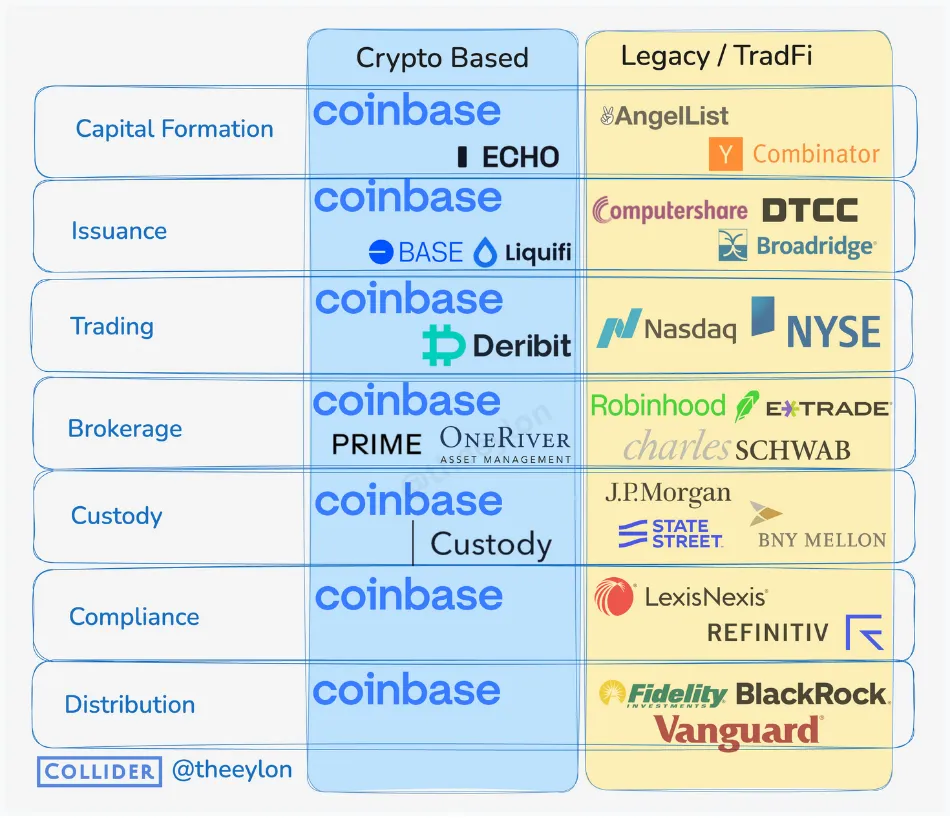
TL;DR: With Echo, Coinbase owns the full lifecycle of capital formation. It controls how value is created, issued, traded, and held, across both its onchain and exchange rails. And since tokens are replacing securities (…and more), Coinbase isn’t integrating with TradFi, it’s replacing it
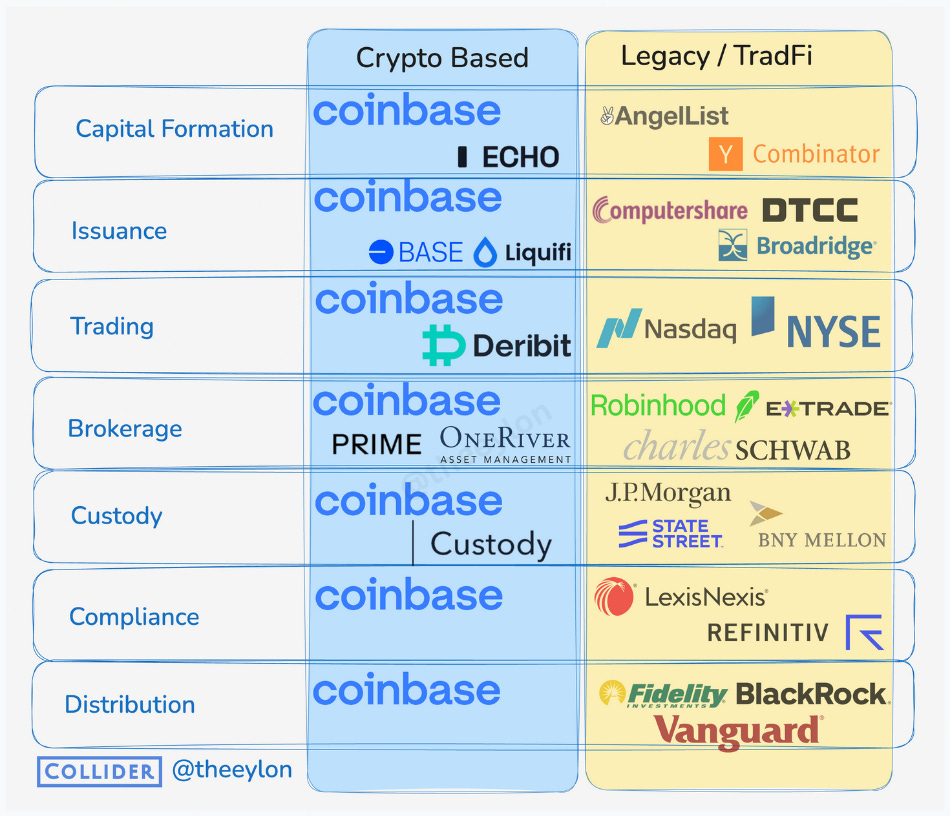
Capitalism; Vertically integrated.
Coinbase’s $375M acquisition of Echo starts as a bridge between traditional fundraising and onchain capital formation, but what it really does is vertically integrate the entire financial lifecycle of a company, or any form of value creation.
Tokens aren’t the future of securities as ownership representation. They are better securities, faster, programmable, global, and open. Public markets are primitive in comparison… (and Nasdaq knows this).
Echo gives Coinbase the first mile, capital formation made open to anyone with basic KYC. Combine that with everything else they already own, like issuance, trading, custody, compliance, and distribution, and you get a closed loop. The full stack of financial value creation, all inside Coinbase.
That means the next startup, protocol, or fund can raise capital, issue ownership, trade it, and manage it, all without touching legacy rails. No banks. No VCs. No borders.
This isn’t about crypto anymore. It’s about replacing the infrastructure of capitalism.
What is Echo?
Echo is an onchain platform for raising capital and issuing ownership directly to communities. It lets anyone participate in private rounds of early stage companies without the walls of geography or accreditation. And its fully compliant.
From the first dollar raised to the last trade executed
Everything now happens on Coinbase’s rails, Both onchain and offchain, retail and institutional.
The Coinbase Stack Now Looks Like This:
- Capital Formation: Echo - onchain fundraising for anyone, anywhere.
- Issuance: Tokens created and distributed through Coinbase’s infrastructure (Base).
- Trading: Deep liquidity across Coinbase Exchange and Base DEXs.
- Brokerage: Direct access for institutions and retail to buy, sell, and participate in new markets.
- Custody: Institutional grade storage, settlement, and safekeeping.
- Compliance: KYC, AML, and identity systems embedded natively across the stack.
- Distribution: 100M+ verified users, direct retail reachh, and institutional relationships.
Coinbase becomes the market infrastructure.
More than Just an Echo
Cobie built Echo to make capital formation permissionless, a global AngelList without accreditation walls or geography limits. Just a light KYC layer, and anyone can back early projects. It’s perfect timing, coinciding with favorable admin in the US meant it also changed how fundraising can work, b
For Coinbase, owning the top of the funnel was obvious. If the next generation of companies raise through Echo, Coinbase captures every downstream flow: issuance, listing, trading, liquidity, settlement, and institutional access. It’s vertical integration that compounds on each step of the way.
And it’s a brand move too. Cobie isn’t just another founder. He’s one of the few S tier credibility / reputation combo in crypto. His involvement gives Coinbase something money can’t buy: cultural legitimacy.
Zoom(er) out
This acquisition signals something deeper. Onchain finance is maturing into real, compliant infrastructure. And it’s not here to collaborate with TradFi. It’s here to replace it.
Coinbase is positioning itself as the financial backbone of the internet’s capital markets, the rails for how capital forms, moves, and compounds.
The next decade of capital formation won’t happen on Wall Street or in Sand Hill boardrooms. It’ll happen onchain, and increasingly, through Coinbase.
Maybe we did occupy Wall Street after all.
Counterpoint: The Risk of Owning the Stack
If Coinbase now owns the full lifecycle of capitalism, it also owns the choke points. That’s the paradox of vertical integration in crypto. The more complete the stack, the more fragile the idea of permissionlessness becomes. Echo was built as neutral infrastructure Under Coinbase, neutrality will drift toward self interest. The same rails that democratize access can also decide who gets to use them.
There’s also a regulatory dimension. Once Coinbase becomes the onchain equivalent of Nasdaq, DTCC, and JPMorgan combined, it inherits all the political liabilities that come with that. You can’t be the infrastructure of capitalism and stay apolitical.
Builders might love the liquidity and credibility Coinbase brings, but dependence is a different story. If every raise, issuance, and trade routes through one company, the onchain capital markets risk recentralizing under a single corporate actor.
So yes Coinbase just built the full stack. But the open question is whether it can stay open.
